
University of Maryland, College Park

RESEARCH NOTES / 2026

Zian Zeng.

Reliable agents,
from action to evidence.

I study when language-model agents should act, how they recover when things go wrong, and whether their apparent success reflects real progress.

M.S. Computer Science · University of Maryland

B.S. Computer Science · University of Hawaiʻi at Mānoa

Portrait of Zian Zeng

“…at the right times, with reference to the right objects, towards the right people, with the right motive, and in the right way.”

Aristotle, Nicomachean Ethics

01 Research map

All publications

Three questions, one loop.

How my research fits together. Select Act, Recover or Evaluate to see its papers.

A chart of my research

3 questions 6 papers

evidence informs the next action

Reliable agents, from action to evidence.

CallAdmitRoleFlowRestoration Is
Not Neutrality
EffectTwinThe Agent or
the World?

evidence informs the next action

Each star is a paper, a manuscript under review. Hover a star for its full title.The dashed ring is one agent episode, read clockwise from 01.

Action admissionManuscript under review CallAdmit: Diagnosing and Efficiently Repairing Over-Abstention in Tool-Call Admission with Fixed-Proposal Certificates

Multi-agent systemsManuscript under review RoleFlow: Self-Evolving Multi-Role Agentic Collaboration via Structural Adaptation

Agent recoveryManuscript under review Restoration Is Not Neutrality: Auditing Visible Budget Controls in Agent Recovery

Stateful repairManuscript under review Correct Statuses, Wrong Targets: Truthful Goal Feedback Can Misdirect Stateful Repair Agents

Recovery evaluationManuscript under review EffectTwin: Separating Recovery Limits from Output-Protocol Effects in Tool-Using Language Models

Evaluation validityManuscript under review The Agent or the World? Verifier Inflation in Persistent-World Agent Evaluation

Earlier publication Disentangling Complex Questions in LLMs via Multi-Hop Dependency Graphs

Earlier publication The American Sign Language Knowledge Graph: Infusing ASL Models with Linguistic Knowledge

Earlier publication Chatbot Dialog Design for Improved Human Performance in Domain Knowledge Discovery

Earlier publication Chain-of-Query Prompting for Efficient Small Language Models in Multi-Hop Open-Domain Question Answering

Earlier publications MoDeGraph Chain-of-Query

Earlier publications ASLKG Vidura

02 Research record

Publications.

Reliable agents, structured reasoning, and systems built around people.

Full academic CV ↗

Action gate
EACL 2027

CallAdmit: Diagnosing and Efficiently Repairing Over-Abstention in Tool-Call Admission with Fixed-Proposal Certificates

Zian Zeng, Jordan Boyd-Graber

20th Conference of the European Chapter of the Association for Computational Linguistics (EACL 2027). Reviewing through EACL 2027.

Action admission

Research focus

Analyzed 3,652 fixed proposed calls to distinguish admission checks’ activity from their contribution. Traceable normalization increased exploratory reduced-policy balanced accuracy from 78.9% to 88.4% on When2Call.
Budget reset
NAACL 2027

Restoration Is Not Neutrality: Auditing Visible Budget Controls in Agent Recovery

Zian Zeng, Furong Huang

2027 Annual Conference of the Nations of the Americas Chapter of the Association for Computational Linguistics (NAACL 2027). Reviewing through ACL Rolling Review.

Agent recovery

Research focus

Audited 60,720 recorded synthesis attempts and replayed 873 programs. A one-line ending cue restored Qwen performance across all 16 primary configurations while showing that visible-prefix controls are not equivalent to an invisible generation cap.

Goal feedback
COLING 2027

Correct Statuses, Wrong Targets: Truthful Goal Feedback Can Misdirect Stateful Repair Agents

Zian Zeng, Furong Huang

32nd International Conference on Computational Linguistics (COLING 2027). Reviewing through ACL Rolling Review.

Stateful repair

Research focus

Built paired repair experiments with 432 units per model and four prompt conditions. Traced misdirected edits to confusion between goal indices and record identities; object-keyed statuses removed index-named edits in pre-specified two-model probes. Reexecuted 183 programs from 72 trajectories.

Twin states
NAACL 2027

EffectTwin: Separating Recovery Limits from Output-Protocol Effects in Tool-Using Language Models

Zian Zeng, Ashok Agrawala

2027 Annual Conference of the Nations of the Americas Chapter of the Association for Computational Linguistics (NAACL 2027). Reviewing through ACL Rolling Review.

Recovery evaluation

Research focus

Built an exact belief-state solver and an independent certificate checker, establishing 199 recoverable and 100 unrecoverable cases in an authored finite model. Emitting actions before explanations improved next-action viability by 11.7–14.3 percentage points across two models.

State audit
NAACL 2027

The Agent or the World? Verifier Inflation in Persistent-World Agent Evaluation

Zian Zeng, Ashok Agrawala

2027 Annual Conference of the Nations of the Americas Chapter of the Association for Computational Linguistics (NAACL 2027). Reviewing through ACL Rolling Review.

Evaluation validity

Research focus

Across 318 runs and nine open-weight models, measured 6.9–19.6 percentage points of inflated success credit on exposed tasks and zero inflation in six structural-control cells. Separated agent work from useful state left by earlier tasks.

Role network
NAACL 2027

RoleFlow: Self-Evolving Multi-Role Agentic Collaboration via Structural Adaptation

Yi Ge, Pan Wang, Xuehao Cui, Zian Zeng, Xu Hu, Heng Huang, Furong Huang

2027 Annual Conference of the Nations of the Americas Chapter of the Association for Computational Linguistics (NAACL 2027). Reviewing through ACL Rolling Review.

Multi-agent systems

Research focus

Coauthored research on self-evolving roles and structural adaptation in multi-agent collaboration. The method exceeded the strongest compared multi-agent baseline by 4.7 points on average across seven benchmarks.

Sign + knowledge
NAACL 2025

The American Sign Language Knowledge Graph: Infusing ASL Models with Linguistic Knowledge

Lee Kezar, Nidhi Munikote, Zian Zeng, Zed Sehyr, Naomi Caselli, Jesse Thomason

Findings of the Association for Computational Linguistics: NAACL 2025 · pp. 7032–7044

Neuro-symbolic learning

Research focus

Coauthored the ASL Knowledge Graph study combining 11 linguistic sources and evaluating three video tasks. The collaborative models achieved 91% isolated-sign recognition accuracy.

Query chain
IEEE Big Data 2024

Chain-of-Query Prompting for Efficient Small Language Models in Multi-Hop Open-Domain Question Answering

Rithika Akula, Roland Oruche, Zian Zeng, Yuanxun Zhang, Marcos Zampieri, Prasad Calyam

IEEE International Conference on Big Data 2024, workshop track · Accepted

Efficient reasoning

Research focus

Using context-aware subqueries for efficient multi-hop question answering.

03 Selected builds

Research meets implementation

Ideas become
systems.

I build across the stack—from reasoning and routing policies to interfaces people can use.

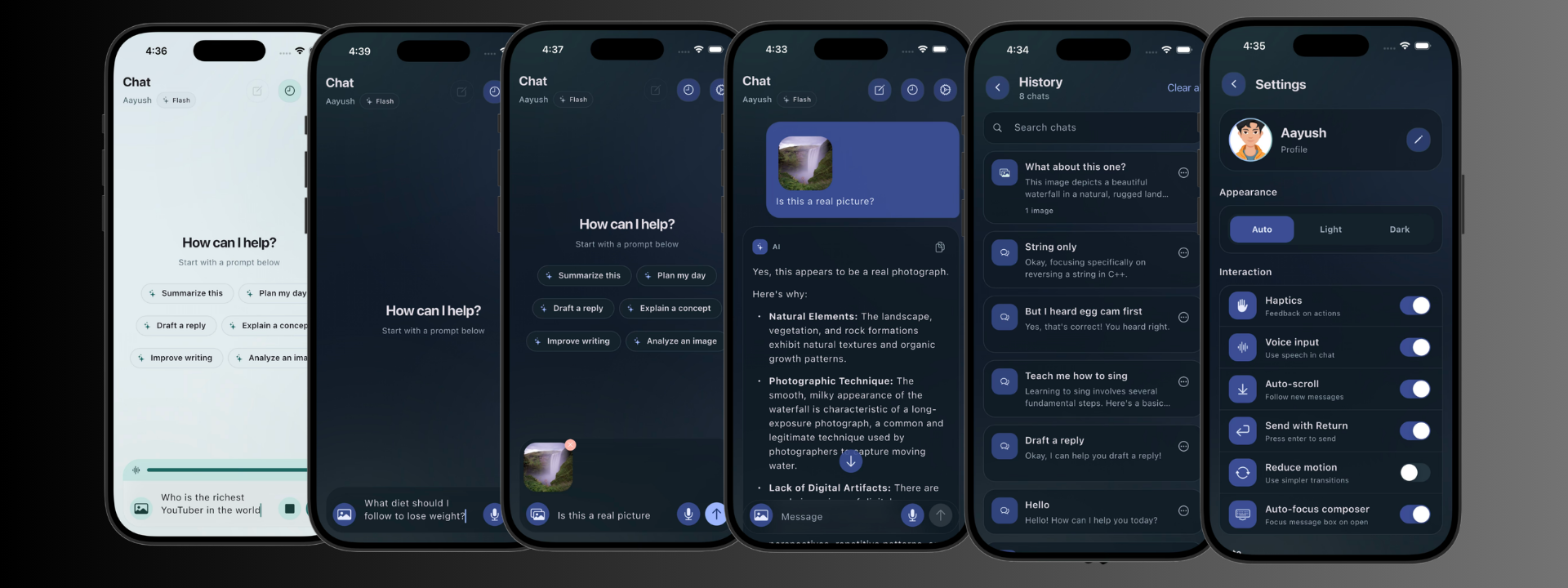
01 / FOUNDER & TEAM LEADER

ORBIT

A constellation of specialized agents for student life.

Built and led a Flutter/Dart prototype with five specialist agents, shared student context, and a Node.js data proxy. Evaluated it with 40 synthetic student profiles. Led the UMD xFoundry entry and 75-page business plan, guiding the team’s writing and charts around student-controlled support, institutional adoption, and a proposed campus pilot.
MULTI-AGENTFLUTTERNODE.JS
ORBIT interface screens showing chat, image understanding, history, and settingsExplore the interface ↗

02 / GLOBAL HACKATHON

Google DeepMind Cactus Compute

The right computation.
At the right moment.

I built hybrid routing across deterministic logic, on-device FunctionGemma, and Gemini cloud fallback.

The challenge: balance tool-call correctness, latency, and local execution.

Deterministic logicFunctionGemma on deviceGemini in the cloud

MY COMPETITION RESULT

#2

Washington, DC
leaderboard

At competition close

5 cities. One global competition.

  • San Francisco
  • Boston
  • Washington, DC
  • London
  • Singapore

Organized by Google DeepMind, Cactus Compute, and AI Tinkerers.

03 / MUIR · RESEARCH IN PROGRESS

When is another
intervention worth it?

MUIR explores marginal-utility routing for retrieval, checking, repair, verification, and stopping.

ObserveEstimate utilityIntervene / stop
View the framework ↗

Undergraduate projects

University of Hawaiʻi at Mānoa

04

January–May 2024

Technical LeadRequirements Lead

Quiz App

I led technical development and requirements for a three-person capstone team sponsored by Professor Edoardo Biagioni. I built the Flutter/Dart student client for a classroom quiz system with a companion instructor desktop app, including photo-based attendance capture, persistent profiles, and real-time submissions. Working through Bluetooth and Android permission constraints, I adapted the student client to LAN-based WebSockets with a shared connection manager across screens.

05

November–December 2023

Project LeadTwo-person VR project

Saber Quest: Echoes of the Fallen

I originated the game concept and led project framing, resource selection, and task allocation for our two-person team. I co-developed the VR action game with Feiyi Chen using Unreal Engine 4.26 and Blueprints, implementing lightsaber effects and activation behavior, controller interactions, menus, player health, and damage/death feedback. I also resolved build, player/saber alignment, and animation/audio issues while integrating the systems across multiple gameplay maps.

06

December 2022

Project LeadFive-person team

Study Partner

I originated the idea and led project framing, resource selection, and task allocation for our five-person team. I co-developed the Meteor/React and MongoDB application to help students organize face-to-face study groups through course-based peer-support profiles, scheduling, and a shared calendar. We documented feedback from five community members and built 12 automated end-to-end test scenarios, with GitHub Actions running ESLint and TestCafe.

04 A little about me

Read my CV ↗
Portrait of Zian ZengHI → MD

Curiosity,
made concrete.

What excites me most about language-model agents is the moment they stop answering and start acting: calling tools, changing the environments around them, and working alongside people and other agents. That is where trust is earned or lost, and it is where I want to work.

My research follows three questions: when should an agent act, what makes recovery reliable, and what counts as real progress? Each asks something different of an agent: judgment before it acts, resilience when things go wrong, and evidence when it claims success.

“And thus the native hue of resolutionIs sicklied o’er with the pale cast of thought,And enterprises of great pitch and momentWith this regard their currents turn awryAnd lose the name of action.”

William Shakespeare, HamletAgents face Hamlet’s dilemma at machine speed: think too little and they act rashly; think too long and they lose the name of action.

Education

Aug 2025–May 2027 (expected)

M.S. in Computer Science

University of Maryland, College Park

GPA: 3.90/4.00. Reliable language-model agents, tool use, recovery, and evaluation.
Aug 2020–May 2025

B.S. in Computer Science

University of Hawaiʻi at Mānoa

Data Science track; Business minor. GPA: 3.88/4.00.

Research experience

University of Maryland, College ParkGraduate research · 2025–present

First author and sole student author on five current manuscripts; led implementation, experimental design, analysis, writing, and revisions. Research with Professor Jordan Boyd-Graber (CLIP Lab), Professor Furong Huang (Furong Lab), and Professor Ashok Agrawala (MIND Lab) spans action admission, agent recovery, and evaluation validity, alongside collaborative work on RoleFlow.

University of Southern California · GLAMOR LabSURE student researcher · Professor Jesse Thomason · June–September 2024

Contributed data-augmentation, decoding, and embedding experiments to neuro-symbolic American Sign Language modeling. Coauthored the NAACL 2025 Findings study combining 11 linguistic sources and three video tasks; the collaborative models achieved 91% isolated-sign recognition accuracy.

University of Missouri · VIMAN LabREU student researcher; continued collaboration · Professor Prasad Calyam · May 2023–October 2024

With graduate mentor Roland Oruche, contributed implementation and experiments to three papers on multi-hop question answering and conversational advising. Implemented four prompting/retrieval comparisons and worked on the Vidura / KnowCOVID-19 scientific-literature platform.

University of Hawaiʻi at Mānoa · Hawaii Digital Health LabStudent researcher · Professor Peter Washington · 2023–2025

Prepared first-author research comparing CNN and Vision Transformer models for autism spectrum disorder classification on 547 eye-tracking images from 59 participants. Compared saliency maps, Grad-CAM++, LIME, and attention maps; also contributed to human-in-the-loop crowdsourcing and multimodal autism/ADHD research.

The next chapter

Let’s ask
better questions.

I’m applying for Ph.D. programs starting in Fall 2027, with a focus on reliable language-model agents and their evaluation.

zianzeng@umd.edu Download my CV ↓